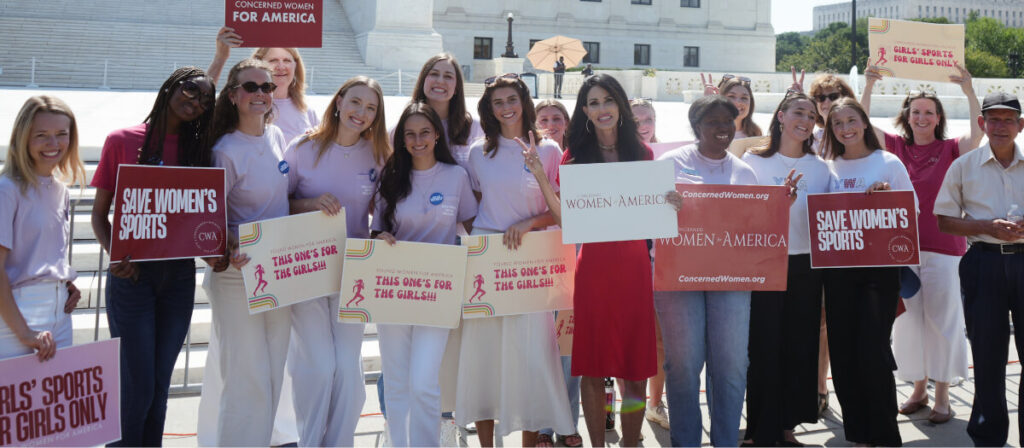

It was a historic day at the United States Supreme Court, where Concerned Women for America (CWA) leaders from around the country gathered to celebrate the Court’s decisions in West Virginia v. B.P.J. and Little v. Hecox, upholding the right of states to protect women’s sports for women only.
“[W]e hold that the States may maintain women’s and girls’ sports for biological females. They may determine eligibility for women’s and girls’ sports based on biological sex. The Constitution and Title IX do not require an overhaul of women’s and girls’ sports throughout America,” wrote Justice Brett Kavanaugh, who authored the majority opinion. He was joined by Chief Justice John Roberts and Justices Clarence Thomas, Samuel Alito, Neil Gorsuch, and Amy Barrett.
Men who self-identify as women insist they should be allowed to trample on women’s rights and opportunities, as they seek validation to compete in the women’s sport category. As the liberal Washington Post put it, “Neither Science, nor the American public, is on their side,” but that did not stop them from going all the way to the Supreme Court for their validation, challenging laws protecting women’s sports in two states: West Virginia and Idaho. According to the trans lobby, the whole world must bow down to the desires of these few men.
Thankfully, the nation rejoices as the Supreme Court puts an end to the whole charade. The Court stated the obvious: “Title IX allows schools to provide separate women’s and men’s sports teams defined by biological sex …”
The majority did not shy away from defining the term “sex,” which CWA has been calling for in numerous court and administrative filings through the years. “The term ‘sex’ in Title IX,” it declared, “cannot plausibly be interpreted to refer to anything other than biological sex.” It also made clear that the term “sex” does not mean “gender identity,” concluding, “Title IX regulations allowed separate sports teams precisely because of the inherent physical differences between biological men and biological women.”
A game of semantics has always been at the core of the efforts to overhaul the fundamental principles of liberty. Here Justice Thomas, as is frequently the case, is a national treasure of clarity. In his concurring opinion, he further helps some members of the Court to define other important terms in the discussion. He wrote:
Men and boys with gender dysphoria are not women or girls, even if they believe that they are. Sex is an immutable “biological” characteristic… it is binary; and “man” and “woman,” “boy” and “girl,” are the terms that correspond to adults and children of each sex… To use language to obscure reality—to show “indifference regarding the truth”—is to lie to the public and cease to treat our fellow citizens “as equal[s].” (Internal citations omitted)
Justice Sonia Sotomayor wrote an opinion (joined by Justices Elena Kagan and Ketanji Jackson) concurring in the judgment in part (she agrees the plaintiffs lose on their Title IX argument), but dissenting in part (she does not agree on the reasoning). The opinion offers no alternative factual findings. It appears to be an appeal to Justice Sotomayor’s famous “empathy standard” by which the law should bend to personal feelings. Especially as it relates to the Equal Protection claim, she goes through the history of discrimination and how hard it is for the plaintiffs and argues for the Court to take more time to consider their claims, but all the twists and turns do not change the law.
Justice Kavanaugh addressed the matter in a footnote, saying, “the Constitution does not require that schools determine eligibility for women’s and girls’ sports based on gender identity rather than biological sex.”
He was also quick to push back on Justice Sotomayor’s presumed moral superiority. He wrote, “[W]e do not accept the dissent’s assumed monopoly on understanding the effects on individuals involved in disputes over transgender athletes.” He continued, “But in conducting the equal protection inquiry, we must also account for the effects on girls who are forced to compete against biological males in sports.”
The plaintiffs’ objection on equal protection grounds was plainly flawed. “West Virginia and Idaho did not violate the Equal Protection Clause of the Fourteenth Amendment by maintaining female sports teams for biological females.” The trans athletes wanted the Court to overhaul major legal precedent also to accommodate their personal desires. In analyzing equal protection, sex-based classifications are allowed when they are “substantially related” to achieve an “important” government objective.
In this case, the Court noted, “the interests of safety and competitive fairness are important interests for purposes of equal protection analysis. And the States’ sex-based classification—limiting women’s and girls’ sports to biological females—is substantially related to those interests.”
“Separate sports teams for biological males and biological females are reasonable: Given the inherent physical differences between the sexes, allowing only biological females to play on women’s and girls’ teams can reduce the risk of physical injury and ensure fair competition.”
The trans-identified challengers wanted the Court to take their personal, individual stories aside, whatever the law generally said. But, once again, the Court reminded them that “the State is not constitutionally required to grant individualized exemptions to specific athletes or subclasses.” Longstanding legal precedent made that clear. “As the Court has long recognized, “[p]erfection in making the necessary classifications is neither possible nor necessary.”
In response to the dissent, Justice Kavanaugh gave a great summary of the Court’s straightforward opinion today that would be helpful as you seek to understand and talk with others about this important opinion:
The Equal Protection Clause allows schools to maintain separate teams for female and male athletes. Schools may determine eligibility for women’s and girls’ teams based on biological sex. That policy is constitutionally justified by the vitally important interests in safety and competitive fairness so as to provide equal opportunities for women and girls to participate in sports. And when a sex-based classification is justified as a constitutional matter, as it is here, States need not make case-by-case exceptions—for example, schools need not make individual exceptions to allow certain biological males to compete in women’s and girls’ sports.
This is a landmark decision that will have great ramifications in our state efforts to protect women and girls in sports. But to be sure, our efforts must continue, now bolstered by this skillful legal analysis from the nation’s highest court.