
Though little known and little discussed, School-Based Health Centers (SBHCs) across the country are pushing sex-rejecting ideology and abortion activism onto school children behind the backs of their parents.
Before the end of 2026, Congress is working to reauthorize $55 million in federal funding for SBHCs across the country. SBHCs were not funded in statute by the federal government until 2009 through Obamacare, and a patchwork of lapsed funding and reauthorizations followed in 2014, 2019, and 2022, with the latest reauthorization set to expire at the end of 2026. As of 2022, federal funding supported 55% of SBHCs nationwide, and in 2023, the Biden Administration gave SBHCs over $105 million dollars across a number of grants from the Center for Medicaid Services, Substance Abuse and Mental Health Services Administration, Health Resources and Services Administration, and Centers for Disease Control. In 2024, there were 4,446 SBHCs in the United States.
The first SBHC opened in 1967 in Cambridge, Massachusetts, in an early effort to provide students with “contraceptives and family planning.” Concerned Women for America (CWA) has battled with SBHCs over parental rights and abortion referrals since their genesis. CWA records note that early SBHCs distributed birth control, Norplant, and condoms to students without parental consent or knowledge, and some transported students from schools to abortion clinics and back. SBHCs were even pushing sex changes as early as 1986.
Former CWA of Georgia State Director Kenda Bartlett recalls that SBHCs were “perceived as the equivalent of the school nurse who is there when a student gets sick at school.” But in reality, CWA of Georgia “spent most of its time addressing the issue of parental rights” with legislators, school districts, and parents.
Not much has changed.
Proponents tout that SBHCs provide a “medical home” to children in low-income communities with a range of services: primary care (annual checkups, acute illness visits, chronic disease management), dental and vision care, mental health services, and sexual/reproductive health services.
But SBHC workers—doctors, nurses, and mental health counselors—are third-party contractors and organizations, not school staff. Given this third-party structure and SBHCs’ historic “contraceptive” mission, organizations like the School-Based Health Alliance, Planned Parenthood, and Reproduction for All (formerly NARAL Pro-Choice America) have hijacked SBHCs to facilitate school-to-abortion and school-to-sex-rejecting procedures pipelines.
Ahead of their 2026 “Stronger Together: Building Healthy Futures for Every Child” conference in Washington, D.C., the School-Based Health Alliance published an itinerary detailing a vision for the event: “Health care professionals, education leaders, youth, and advocates will come together to connect, spark new ideas, and gain actionable strategies—leaving energized, inspired, and ready to make a bigger impact in their communities.”
The description appears harmless, but the conference featured agenda items such as “From Intent to Practice: A Toolkit for LGBTQ+ Inclusive Care in School-Based Health Centers,” “Advancing Reproductive Justice for Youth via School-Based Care and Statewide Collaboration,” and “Empowering Youth to Challenge Reproductive Health Stigma in Schools.” These “actionable strategies” are highly problematic.
There are countless real-world examples of SBHC-based abuses.
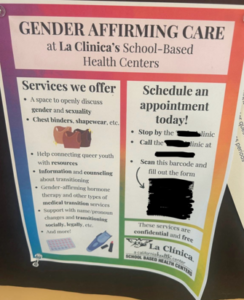
In California, La Clinica SBHCs advertised so-called “gender affirming care,” chest binders, “gender affirming hormone therapy and other types of medical transition services,” and legal name changes on school grounds:
A student article in the Illinois’ Evanston Township High School (ETHS) newspaper boasted the following:
We’re living in a post-Roe world. Illinois may be—as of yet—unaffected, but looking forward to college decisions, to career paths, to places to settle down, we cannot escape the repercussions of the Supreme Court’s decisions … The hub of reproductive care and information at ETHS is room H101—the Health Center. Nestled into a dark blue hallway between H Hall and the first floor of the North wing, you can find a fully functioning, free of charge, professionally run primary health clinic, with a quiet waiting area and smiling staff — right next to your algebra class.
The Health Center has a one-time consent form, which must be signed by parents to use the clinic for any purpose. Once this form is signed, whether it’s for reproductive care, a sports physical, or anything else, students have full access to use the health center’s services. This means that, with nurse approval, students can get prescriptions for short-term hormonal birth control like the birth control pill and other similar methods. However, even without the parental consent form students have access to free condoms and Plan B, an emergency contraceptive that can be taken up to 72 hours after sex.
In another Illinois publication, two ETHS nurses admitted to helping students bypass parental consent laws to obtain abortions and refer students to abortion clinics.
These admissions highlight a critical flaw of SBHCs: secrecy. Parents across the country are systematically shut out of their children’s SBHCs. In most schools, the one-time consent is distributed and signed at the beginning of the school year, and parents, thinking their signature simply allows their child to be seen by a nurse for a fever or a broken arm, sign away. But that one time signature allows SBHCs to give virtually any service to a student, including “gender-affirming care,” vaccines, and contraception prescriptions.
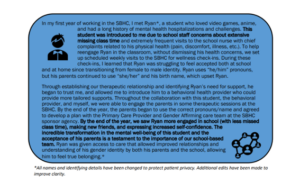
In Massachusetts, SBHC staff submitted the following testimonial to an annual report, detailing a SBHC staff-directed gender transition of a minor:
In Oregon, SBHCs advise students that state law permits minors over the age of 14 that no parental consent is required for medical procedures. And, in Washington, most SBHCs provide so-called “gender affirming care” on school grounds. Most recently, Defending Education reported that a Framingham, Massachusetts Public School advertising school-based health centers for “medical transition” and cross-sex hormones. These examples barely scratch the surface. SBHCs are designed to facilitate secret abortions and gender transitions.
While SBHCs may benefit some communities, studies show that SBHCs provide no statistical improvement in student academic outcomes. They may, in fact, be harming students: in 2023, the American Pediatric Society found that students using SBHCs were more likely to be diagnosed with gender dysphoria than those who did not.
The over fifty years of unaccountable parental rights abuses, abortion activism, and transgender ideology in SBHCs must come to an end. As a funding deadline approaches for the SBHC program, conservatives in Congress must take this opportunity to eliminate waste, fraud, abuse, and sex-rejecting ideology from a program funded by American taxpayers. Members must not reauthorize the SBHC program without strict statutory prohibitions on secret gender transitions, sex-rejecting procedures, and abortion referrals—Concerned Women for America Legislative Action Committee (CWALAC) will oppose any reauthorization absent those guardrails.