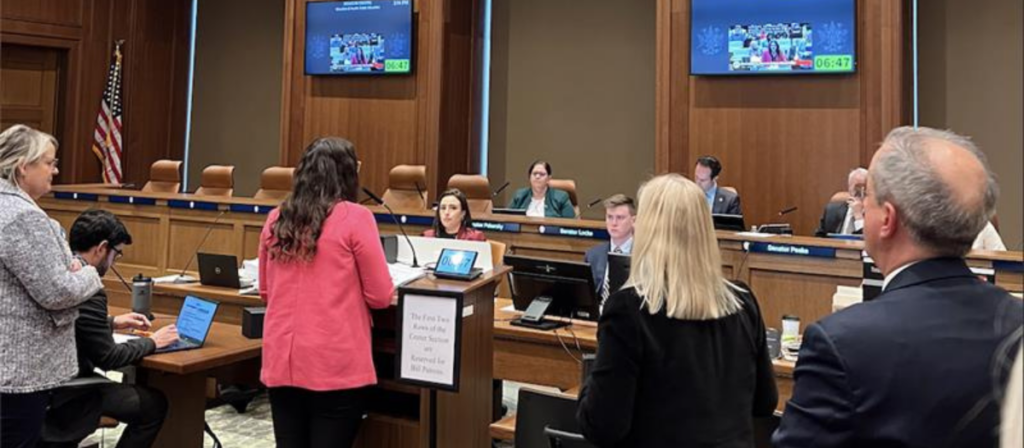

“God created two distinct sexes, male and female.” (Genesis 1:27) Those are the words that I said before the Kentucky State Legislature when a Fairness in Women’s Sports bill was introduced in Kentucky in 2022. I was a senior in high school and had played sports my entire life. A week before testifying, I finished my final swim season and was preparing to figure skate at the collegiate level the following year. Growing up, it was common sense that girls played against girls and boys played against boys in sports. If I were in a relay of four people and one of my female teammates was sick, we could never bring in a male swimmer to complete the relay; that would have been unfair. That was a commonsense reality that I knew from the age of five. But here I found myself on a Tuesday morning, at age seventeen, before the Kentucky State Legislature, stating both Biblical and biological truth: that “there are two distinct sexes”—one of the most foundational truths in Scripture that has existed since the beginning of time.
Men competing in women’s sports began to have a noticeable impact in 2017 when male athletes in Connecticut won 15 state titles over a three-year period that had once been held by nine different female athletes. In 2020, Idaho was the first state to pass Fairness in Women’s Sports legislation. Then, in 2022, this issue became a large-scale one when William Thomas (a.k.a Lia), a former swimmer at the University of Pennsylvania, took to the pool and went from ranking #462 in the men’s category to #1 in the women’s category. When Lia and Riley Gaines tied, they gave the trophy to Thomas “for photo purposes.”
This decision opened the gates. When male athletes compete in women’s sports, they are taking away opportunities for female athletes to win medals, place at championships, and secure a spot on a collegiate team. In addition, it opens the door for injury when men are playing against female athletes, like the incident in North Carolina, when volleyball player Payton McNabb was injured while competing against a male.
Allowing biological males to compete in women’s sports is an attack on science, on physical reality, and a betrayal of women’s rights which is why it is imperative to continue standing for truth. Thankfully, over the last four years, there has been significant progress in the fight to protect women’s sports. Twenty-seven states have passed legislation to protect female athletes; HR 28 is a national Fairness in Women’s Sports bill that has passed through the House of Representatives; President Donald Trump signed an Executive Order in February of 2025 to protect female athletes, and there have been many female athletes such as Riley Gaines, Paula Scanlan, Payton McNabb, Selina Soule, Kaitlynn Wheeler, Macy Petty, and many others who have tirelessly advocated for female athletes. Young Women for America leaders have been right there alongside them.
Tomorrow is a huge day. One that I never thought we would see when I first testified on this issue four years ago. On Tuesday, January 13, this issue heads to the highest court in our nation with oral arguments in two cases: State of West Virginia v. B.P.J. and Little v. Hecox. Both cases are instrumental to future protections for women in sports at the state level. This is an exciting day as we continue to work to protect female athletes nationwide.
Tomorrow, as we head to the Supreme Court, we are not just standing for ourselves as young women, but for our future daughters, little sisters, cousins, and the next generation of female athletes, so that they will have a fair and equal playing field, too.
Halli Gravley is a Young Women for America Ambassador in Virginia.