
Boys are still stealing trophies from girls. On the racetrack, the volleyball court, and even on the dance stage. For the third year in a row, a female-identifying 15-year-old boy has won in his age category at a regional Irish Dance competition, rewarding him with the chance to compete as a girl at the Irish Dance World Championships in the spring.
As a competitive Irish dancer myself, there was a time when I thought my sport would be immune to the encroachment of gender ideology. After all, this is a world in which female competitors wear dresses covered in rhinestones, towering curly wigs, and spray-on tans. For a boy to compete as a girl would require him to essentially dress in drag, in front of an audience of hundreds of other dancers and parents. What young boy would voluntarily sign up for that?
But three years ago, I learned that I was naïve. At the 2023 Southern Region Oireachtas in Dallas, Texas, a competition I myself participated in as an adult, a then 12-year-old boy won in his age category, as a girl. After Concerned Women for America (CWA) highlighted this story in 2023, a maelstrom engulfed the Irish dance world. For regional competitions, the top 10 dancers qualify for Worlds. By winning his age group, the boy not only took the top spot from a girl but ensured that another girl would not get the last highly coveted qualifying spot. The following spring at Worlds in Scotland, a competition where only the top 20 receive a medal to show for their accomplishment, the boy placed in the 20th spot, enraging not just American dancers but competitors from all over the globe.
CLRG, the Dublin-based governing body of Irish Dance, currently allows dancers to compete in the category with which they identify, rather than that which corresponds to their biology. However, 2023’s competition upset led over 6,700 parents, teachers, and dancers to sign a petition asking CLRG to change its policy.
In response, CLRG held a vote on whether to reaffirm its old policy or enforce the commonsense notion that dancers compete in the category that aligns with their biological sex. That motion was, ultimately, defeated. A CLRG spokesperson told news outlets that they are “committed to creating a safe and inclusive environment for every dancer in our community.”
But as more and more girls lose titles and qualifying spots to boys, as all of their years of hard work comes to nought, those words ring hollow. Many parents have chosen to pull their daughters out of the sport, encouraging them to pursue a less arduous and expensive hobby that will not unfairly pit them against the opposite sex. Rather than cause international outrage, the boy’s win at this year’s regionals in Orlando has barely caused a ripple. Those dancers in his age category that have not stopped competing have simply, and tragically, accepted that he is here to stay, as a girl.
Just as in any other sport, competitive Irish dance is extremely rigorous and time consuming. The stamina required to complete three championship rounds of Irish dancing requires competitors to have a much lower resting heart rate than the average adult. Many tricks require the ability to jump explosively off the ground and then freeze in midair, often while wearing heavy fiberglass shoes. The high-speed rhythms must be unfailingly precise. And for young dancers, all of this must be accomplished while juggling final school exams with cross training in the gym, hours in the dance studio, physical therapy, and time spent traveling to competitions all over the world. Most of them do all this in the hopes of one day dancing at the World Irish Dancing Championships, something for which only 1% of dancers ever qualify.
It is difficult enough for a girl to win when she is competing against fellow female dancers. It’s nearly impossible when pitted against a biologically advantaged male who can jump higher, move faster, and naturally has more stamina to make it through his rounds.
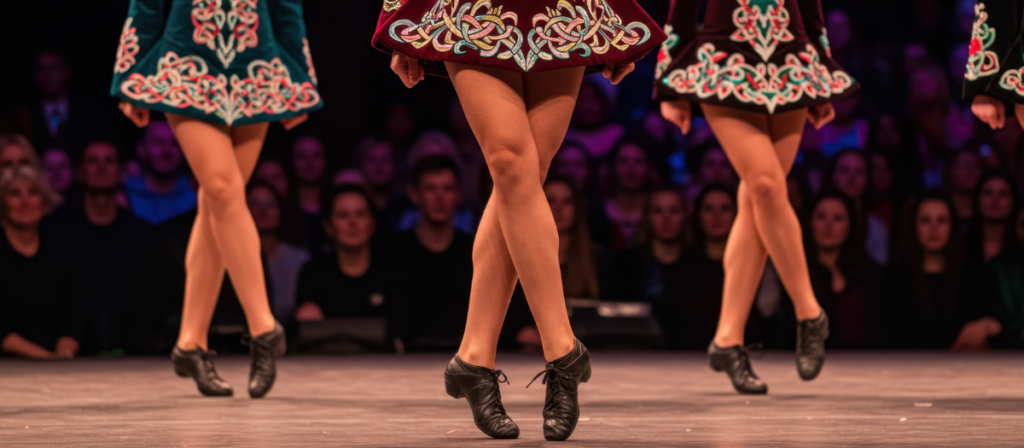
But even more than the athleticism involved, gender ideology has no place in Irish dance because the sport, at its core, is a celebration of the differences between the sexes. Women wear the softer laced “ghillies” and dance the more feminine slip jig. Male choreography emphasizes power and strength through more complex rhythms and sound patterns. In team dances, called “ceilis,” a male is always the lead the dancer, enabling his female partner to execute the graceful turns and footwork synonymous with Irish dance. The costumes especially highlight sexual difference, with women in short, form fitting dresses with curly locks, men in waistcoats and pants. In this art form built on tradition, allowing the sexes to be interchangeable threatens the integrity of the sport itself.
Much progress has been made on the issue of protecting women’s sports from men. Earlier this year, President Trump signed an Executive Order reaffirming the purpose of Title IX. The International Olympic Committee recently announced that they are adopting a new, science-based policy intended to keep women’s sports female. More brave female athletes are standing up against male competitors, refusing to play along with the unfairness of gender ideology. Numerous bills have been introduced in Congress to permanently ban men from women’s sports at NCAA-affiliated schools and Olympic sports leagues.
But for private sports leagues like Irish dance, there is little that politicians can do. It will be up to parents and the dancers themselves to continue to call out the injustice of gender ideology and to refuse to accept the spineless decisions of the CLRG and other powers-that-be. On behalf of the young dancer that I once was and the little girls just now discovering this beautiful sport, we at CWA will continue to fight until gender ideology is fully eradicated, until 15-year-old girls are no longer asked to give up their dreams and hard-earned trophies to boys.