
Written by Sarai McCullough and Serenity Porch, Government Affairs and Public Policy Interns at Concerned Women for America
On June 30, 2026, the House Judiciary Committee’s Subcommittee on Immigration Integrity, Security, and Enforcement held a hearing titled “Sanctuary Policies: Victims’ Perspectives.” This hearing brought together lawmakers, a sheriff, a policy analyst, and two grieving parents to examine how sanctuary policies- when local government shields illegal immigrants from deportation- in states like Illinois and California, have affected public safety.
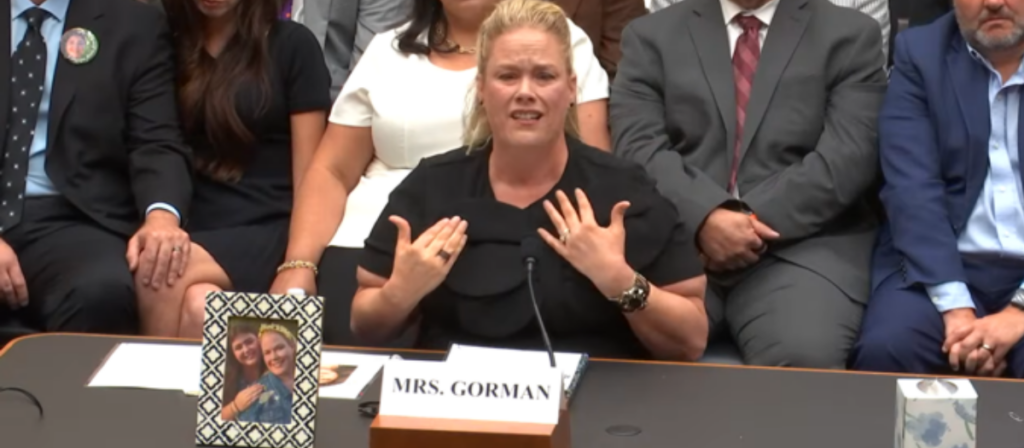
At the center of the hearing were two families who have become the tragic victims and public faces of this debate: Jessica Gorman and Joe Abraham, both of whom lost daughters to illegal immigrants who had already been through the immigration enforcement system once before.
Jessica Gorman’s daughter, Sheridan, was an 18-year-old freshman at Loyola University in Chicago. On March 19, 2026, she was shot and killed near her campus while walking with friends along the lakefront, hoping to catch a glimpse of the northern lights. The man who murdered her, Jose Medina-Medina, is an illegal immigrant from Venezuela who had been apprehended and released into the country by Border Patrol in 2023, then released again after a shoplifting arrest in Chicago. He never appeared for his court date.
At the hearing, Gorman emphatically questioned Congress on why local law enforcement refused to cooperate with ICE, and why officials are prohibited from even asking about a suspect’s immigration status. “Why do American citizens matter less than illegal aliens?” she pleaded with the committee, further asserting that she and other families “cannot be buried by your slogans.” This came after Rep. Pramila Jayapal (D, WA – 07) claimed the effects of sanctuary policies were insignificant while sitting directly across from parents whose own children were tragically murdered as a result of these laws. Jayapal continued to show her lack of respect for these families through lamenting that Congress has held “four hearings on this issue already” and could be using their time for more “important” matters.
Joe Abraham’s daughter, Katie, was killed in January 2025 when an intoxicated driver crashed into the back of her car at a red light in Urbana, Illinois, then fled the scene. The driver, a Guatemalan national who had been deported once before and re-entered the country illegally in 2022, was later found to have obtained an Illinois driver’s license despite being unable to read, write, or speak English or Spanish. Abraham told the committee that his daughter “was not a statistic” and that Congress owed it to victims to demand transparency about how such failures happen.
Both parents’ testimony set the tone for the hearing, but it quickly fell into a heated debate and partisan divide, even as both sides claimed that they wanted to see the loss of these two young women taken seriously.
Republicans on the committee argued that sanctuary policies, which limit how much local law enforcement can cooperate with federal immigration authorities, directly contributed to both deaths. Rep. Jim Jordan (R, OH – 04) shared the same sentiment that Subcommittee Chairman Tom McClintock (R, CA – 05), who is the sponsor of a bill called the Sanctuary Jurisdiction Shutdown Act, said: Republicans would hold “as many hearings as it takes” to get the legislation passed. Other Republican members pointed to specific state laws, including Illinois’ TRUST Act (5 ILCS 805), that the GOP claimed prevented local police from sharing information about suspects with ICE. Amador County, California, Sheriff Gary Redmond testified that although state law forbids him from cooperating with ICE, he has chosen to notify federal agents when possible, including in a case where a man arrested for the sexual abuse of a 14-year-old girl received a reduced plea deal locally; ICE picked the man up about two weeks after his release. Redmond said he has contacted ICE eight times about potential removals from his jail since 2025, but has also been required under the Golden State’s California Values Act (SB 54) to release 16 people arrested for lower-level offenses without notifying federal authorities.
Democratic Congressmen on the committee argued that sanctuary policies do not stop ICE from enforcing federal law, and that the real public safety threat comes from federal resources being diverted away from investigating serious crimes like child exploitation and trafficking. Sarah Pierce, Director of Social Policy at Third Way, testified that tens of thousands of federal agents with specialized experience in areas like child exploitation and human trafficking have been reassigned to immigration enforcement, which she argued leaves other serious crimes under-resourced. She also told the committee that the administration had canceled more than $820 million in public safety grants to states and delayed the release of billions more.
Several Democratic members joined Rep. Jayapal, including Rep. Jerry Nadler (D, NY – 12) and Rep. Mary Scanlon (D, PA – 05), in arguing that there have been an unfair number of hearings on sanctuary policies and insisted lawmakers should also examine other issues, including court rulings on the administration’s immigration policies. They cited data from ICE showing that a majority of people currently in immigration detention “have no criminal record.”
The hearing also included a pointed exchange over what should count as a “serious” offense. Republican members pressed Pierce on whether crimes like the DUI and shoplifting cases tied to the deaths of Katie Abraham and Sheridan Gorman would qualify, questions Pierce said deserved more time than the hearing allowed.
Throughout the hearing, Republican members repeatedly returned to the gripping personal stories of Gorman and Abraham, highlighting that truth matters. Rep. Mike Lawler (R, NY – 17) told Jessica Gorman, “This nation and this Congress owes you an apology.” Rep. Jeff Van Drew (R, NJ – 02) told Sarah Pierce directly that the hearing was about “real people, real issues,” urging her to address the parents seated next to her.
For Gorman and Abraham, the hearing was a chance to put faces and names behind a debate that is too often reduced to statistics and talking points. As Gorman told the committee near the closing of her testimony: “[My daughter] was worth protecting. She was worth saving.”